How to appoint a civils or drainage contractor for a project
A procurement-led checklist for appointing civil engineering and drainage contractors to highway and development packages, with scope, approvals and delivery interfaces to test.

At a glance
| Procurement question | Evidence to request | Check before award |
|---|---|---|
| Scope | Inclusions, exclusions, drawings and assumptions | Compare bids on the same boundary |
| Approvals | Named owner for each authority or undertaker interface | Confirm route and status with the decision-maker |
| Delivery | Team, sequence, inspections and quality records | Test against site constraints and dependencies |
| Handover | Tests, as-builts and close-out responsibilities | Match requirements to contract documents |
Choose a civils or drainage contractor by checking whether its scope, team, controls and programme fit the package. A headline price can hide gaps in design, approvals, utilities, traffic management, temporary works or handover. Define these boundaries before tender. Then compare each bid against the same scope and assumptions.
The right contractor depends on the package. A drainage installation on a development, an adopted highway scheme and a public-realm contract can involve different asset owners, approvals and constraints. The words “civil engineering contractor” or “drainage contractor” describe a broad market, not a complete specification of the work you need delivered.
Start with a package definition
Describe the work in measurable terms: location, extent, drawings, specifications, quantities where established, interfaces and exclusions. State what is designed, what is already approved and what remains subject to approval. Identify whether the package includes excavation, temporary works, drainage, ducting, utilities coordination, traffic management, surfacing, reinstatement, testing or as-built records.
Separate confirmed facts from assumptions. If a drawing is preliminary, say so. If an outfall, utility diversion or road-space booking is unresolved, list it as an open interface rather than burying it in a general note. Ask bidders to identify their assumptions and qualifications in a consistent format.
Set out the intended route for approvals. New estate roads intended for adoption may require a Section 38 agreement. Works to an existing highway may involve a Section 278 agreement. New apparatus in the street may require a Section 50 licence. Proposed sewer adoption may involve a Section 104 agreement. These mechanisms serve distinct purposes; identify which apply with the relevant authority or asset owner.
Test relevant delivery capability
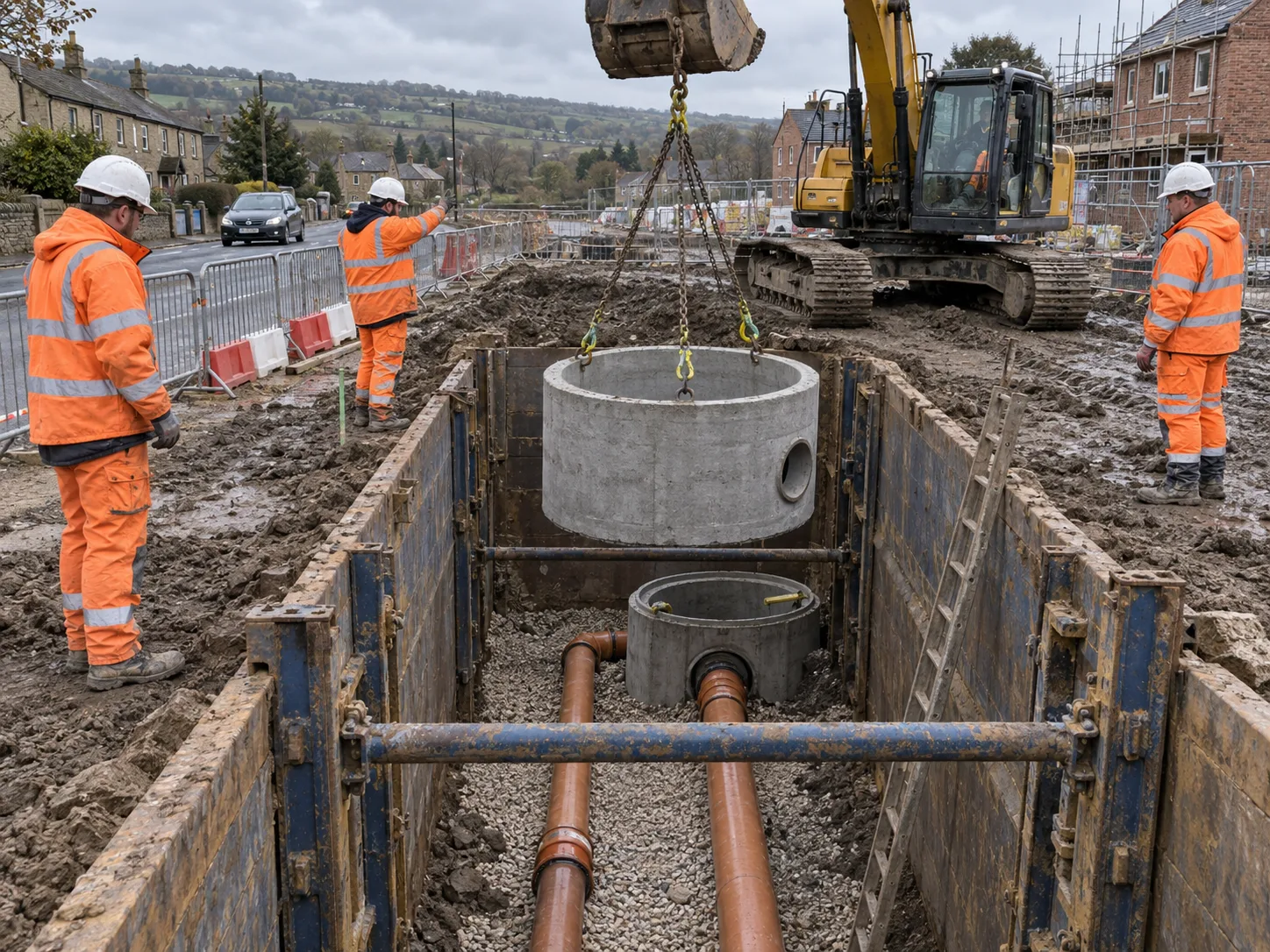
Ask for evidence that relates to the work type and operating environment, not generic claims about being a “one-stop” contractor. For drainage works, examine how the contractor plans excavation, temporary support, pipe installation, connections, testing and inspection. For highways packages, ask how it coordinates traffic management, permits, road-space constraints, utilities, reinstatement and materials traceability.
Check the proposed project team and supply chain. Identify who will manage the site, who holds design or temporary works responsibilities, and which specialist activities are subcontracted. Ask how the contractor verifies that the people and equipment proposed are available for the dates in the tender. Clarify who makes decisions when site conditions diverge from the drawings.
Request examples of comparable work only where they are relevant and verifiable. Establish the contractor’s role, the package scope and the evidence available. A reference to a large project does not show that the bidder delivered the particular work you are procuring. Do not assume past performance transfers automatically to a different authority, contract form or site.
Compare commercial submissions on a like-for-like basis
Use a tender schedule that asks each bidder to price the same defined scope and identify exclusions. Request a breakdown that helps you understand the main work elements and interfaces, while avoiding false precision where the design is not mature enough. Invite bidders to state what information they need before confirming an approach.
Compare qualifications carefully. One bid may omit traffic management, testing, disposal, reinstatement, utility coordination or handover records that another includes. Those differences matter even when the tender totals look comparable. Record each assumption, decide who owns it and resolve material gaps before appointment.
Clarify the contract basis, payment mechanism, change control, insurance requirements and responsibility for permits and approvals. Confirm who supplies bonds or other security if the contract or authority agreement requires them. These terms are project-specific; do not rely on an informal tender note to replace the signed contract or authority documentation.
Ask bidders to describe how they will manage instructed changes and unforeseen conditions. A sound process identifies the issue, makes the area safe, records the effect, obtains the required instruction or approval and updates the programme and cost position. Avoid a tender comparison that treats all unknowns as if they were already resolved.
Check the programme and dependencies
Ask for a programme that shows design information, approvals, procurement, mobilisation, construction stages, inspections, testing and handover. It should identify dependencies such as utility searches, diversion works, road-space availability, permits, outfall permission and third-party inspections. A bar chart without those dependencies gives little basis for judging delivery risk.
Check whether the proposed sequence is compatible with the authority’s working restrictions and the site’s access needs. Traffic management can shape how work is built; it is not simply an add-on at the end of the tender. Confirm whether the bidder’s sequence relies on a closure, temporary signals, restricted hours or a particular road-space slot.
For a package that includes a new sewer, confirm when the undertaker needs to inspect the work and what evidence is required before it is covered. For adoptable highway work, identify the authority hold points and close-out information. Agree a process for notifying inspections and controlling drawing revisions before the first excavation.
Assess safety and quality controls
Review how the contractor will plan and supervise excavations, temporary works, traffic management and interfaces with the public. Look for a clear chain of responsibility, competent planning and a practical method for revisiting controls when conditions change. A policy statement alone does not show how controls will work on this site.
Quality arrangements should match the specification and the asset being delivered. Ask what inspections and tests are proposed, which records will be retained and how defects or non-conformances are closed. Confirm that the contractor can provide the as-built information and certificates required by the client, authority or undertaker.
Check how materials and waste will be managed. The tender should identify relevant materials, delivery constraints, storage arrangements, disposal assumptions and the evidence needed for the project record. The exact requirements depend on the specification and site conditions, so set them out in the procurement documents.
Make the decision traceable
For a traceable decision, use an evaluation matrix tied to the stated requirements. Score capability, methodology, programme, quality, safety, commercial clarity and relevant evidence separately. Record why a submission meets or misses each criterion. If an item is mandatory, define the pass/fail test before tenders arrive rather than retrofitting it to favour a particular bidder.
Resolve clarifications consistently. Share material answers with all bidders where procurement rules require it, and preserve a clear record of changes to tender information. Before award, reconcile the preferred submission with the contract scope, exclusions, drawings and programme. Carry agreed assumptions into the appointment documents.
The award is not the end of procurement control. At mobilisation, hold a package review covering scope boundaries, current drawings, approvals, permits, contacts, inspection points, programme dependencies and records. This closes the gap between what was compared and what the site team will actually deliver.
Warning signs in a contractor proposal
Be cautious if the proposal does not say what is excluded, treats approvals as someone else’s problem without naming who, gives a fixed start date before road space or permits are confirmed, or offers no clear plan for inspections and handover. A submission that cannot identify its key assumptions is difficult to compare and difficult to manage after award.
Similarly, broad capability claims should be tested against the proposed team, work method and evidence. Ask for clarification rather than assuming missing information means it is included.
Discussing a package with Civcon
Civcon delivers drainage and highways infrastructure packages, including drainage installation, deep drainage, highway drainage and traffic management. To discuss a potential package, provide the location, scope, current drawings, specification, approval status, programme constraints and known interfaces. This gives Civcon a basis to review the actual requirement rather than respond to an undefined request for a “civils contractor.”
How we approach it
First, define the package boundary and separate confirmed information from assumptions. Speak with the client team about design responsibility, then confirm approval routes with the relevant authority or undertaker. Issue one scope and tender schedule to each bidder. Ask them to identify exclusions, dependencies, proposed team, inspection controls and handover records. Compare like with like, resolve material gaps in writing, and carry the agreed scope into the appointment. At mobilisation, review the current drawings, contacts, permits, hold points and open interfaces with the site team.
The table helps structure evaluation; it does not replace the contract or procurement rules.
Sources and next step
Relevant statutory frameworks include Highways Act 1980, Section 38, Highways Act 1980, Section 278, Water Industry Act 1991, Section 104, and New Roads and Street Works Act 1991, Section 50. Confirm current authority and undertaker procedures for the specific project.
Before inviting tenders, issue a scope with clear boundaries, approval status, interface responsibilities and comparable pricing assumptions. Evaluate evidence against the work required, then close any material qualification before appointment.
Primary references for common approval interfaces include the Highways Act 1980, Section 38 and the Water Industry Act 1991, Section 104. Confirm which route applies with the responsible authority or undertaker.