Drainage adoption: getting a SuDS scheme past the water company
Why surface water drainage holds up more sites than any other discipline, how Section 104 adoption really works, and the build details that cause a refusal at final inspection.
Drainage is the quietest item on most programmes and the one most likely to cost you six months. It rarely fails at design stage, because a drainage strategy that satisfies a planning condition is a drawing and a calculation. It fails at adoption, when a water company inspector walks a scheme that has been built and finds something they will not take on.
That gap between an approved strategy and an adoptable asset is where the money goes.
Two separate approvals, often confused
Planning. The lead local flood authority is a statutory consultee on surface water drainage for major development. They assess discharge rates, attenuation volumes, exceedance routing and the treatment train against national and local standards. Their sign off discharges a planning condition. It does not commit anyone to maintain anything.
Adoption. Separately, if you want the water company to own and maintain the sewers, you enter a Section 104 agreement under the Water Industry Act 1991 and build to the Design and Construction Guidance that sits under the Codes for Adoption. This is a technical standard with its own requirements, and it is stricter than what a planning drainage strategy usually shows.
Schedule 3 of the Flood and Water Management Act 2010 has been discussed as the route to a separate SuDS approving body for well over a decade and remains unimplemented in England. Until that changes, surface water still runs through the planning system and the adoption route above, and anything the water company declines to adopt has to be maintained by someone else. That someone is normally a management company funded by the residents, which is a commercial decision worth making deliberately rather than by accident at the end of a job.
What actually gets adopted, and what does not
The pipe network is straightforward. Manholes, gullies, connections and the carrier drain in an adoptable road are routine, provided they are built to standard and the records exist.
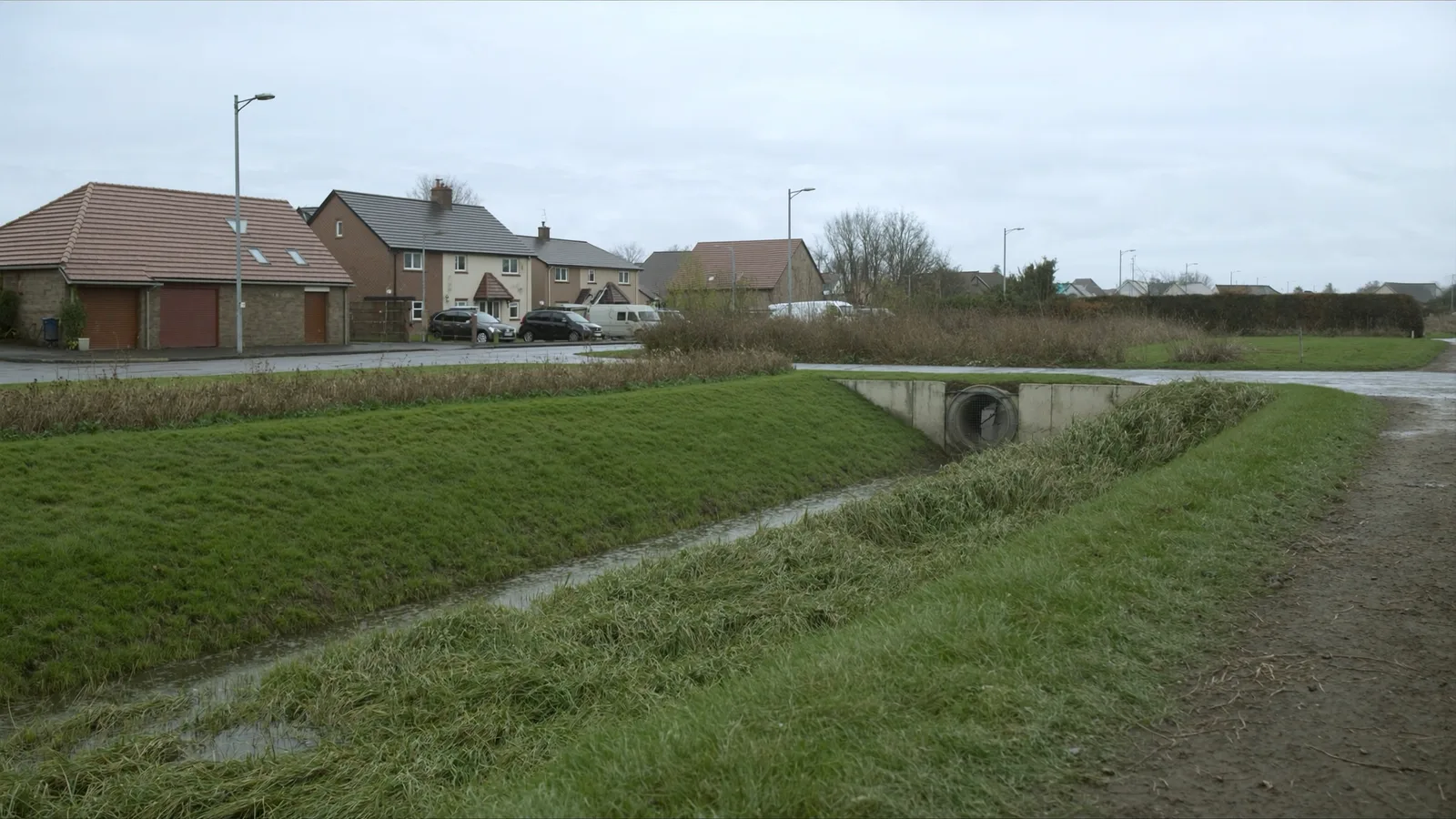
Surface features are where it gets specific. Water companies will consider swales, basins, filter drains and permeable paving under the Codes for Adoption, but each carries conditions on gradient, side slopes, access for maintenance plant, planting, silt management and outfall control. A basin with 1 in 2 side slopes and no vehicular access to the outfall is not going to be adopted whatever the drawing said, because nobody can get a machine to it to desilt it.
Proprietary treatment devices, private drainage, anything within a private curtilage, and features serving only unadopted areas stay private.
The build details that cause a refusal
We are called to remediate other people’s drainage often enough to see the same short list.
Pipe bedding and cover to the wrong class. The bedding class is a function of pipe material, diameter, depth and loading. It is on the drawing. It is also the first thing lost when a gang is trying to get a run in before the weather turns.
Failed CCTV survey. The adoption survey looks for displaced joints, infiltration, deformation, standing water and debris. Standing water in a shallow gradient run is the frequent one, and it is usually a levels problem set weeks earlier by the person who dug the trench, not a pipe problem.
Silt. A drainage system commissioned during the construction phase, without proper interception, arrives at final inspection full of construction silt. Cleaning it is not free and it will be your cost.
Manhole build quality. Benching that does not match the flow, steps out of tolerance, cover levels that do not sit with the finished surface, missing safety chains. Small items, all of them re-visits.
Attenuation that was never proved. If the basin or tank does not hold what the calculation said, that is discovered by survey at the end. Volume is set by the shape you actually dug.
No as built information. Adoption needs as built drawings, survey data, CCTV, test records and a materials trail. Assembling it retrospectively for a job that finished eight months earlier is painful and sometimes impossible.
Sequencing, which is the actual lever
Almost all of that list is a sequencing problem rather than a workmanship problem.
Build the drainage carrier network early enough to be useful, but protect it. Temporary silt traps at gullies, plugged connections, and a rule that no site water enters the permanent system before it is protected. It costs very little and it saves a jetting bill and a re-survey.
Survey as you build rather than at the end. Invert levels recorded per manhole as they are constructed cost nothing and catch a gradient error while it is one length of pipe rather than a whole run.
Get the water company to inspect at construction stage, not just at the end. An inspector who has seen the bedding in the trench is an inspector who is not asking you to excavate it again.
Do the SuDS features last, or protect them absolutely. A basin used as a haul route or a material store during the build has been compacted, contaminated and regraded, and it no longer performs as designed.
What this means for programme
On a typical residential scheme, treat drainage adoption as a twelve to eighteen month process running from Section 104 application through to the adoption certificate, with construction sitting in the middle and the maintenance period running after. It is not a task that starts when the pipes go in.
The developers who get this right make one decision early: they treat the drainage as an asset being handed to a third party with an inspection regime, not as a service under a road.
Where we come in
Drainage is core Civcon work. We install carrier drainage, attenuation, SuDS features and outfalls across West Yorkshire for local authorities, water companies and principal contractors, and we build to the adoption standard as the default rather than as an upgrade.
If you have a scheme with a drainage strategy and no build plan behind it yet, or one already in the ground that is failing inspection, tell us about the site.