Installing traffic signals on a live highway
What a signal installation involves once you take away the drawing: ducting, chambers, detection, temporary signals, commissioning and the handover to the authority's control room.
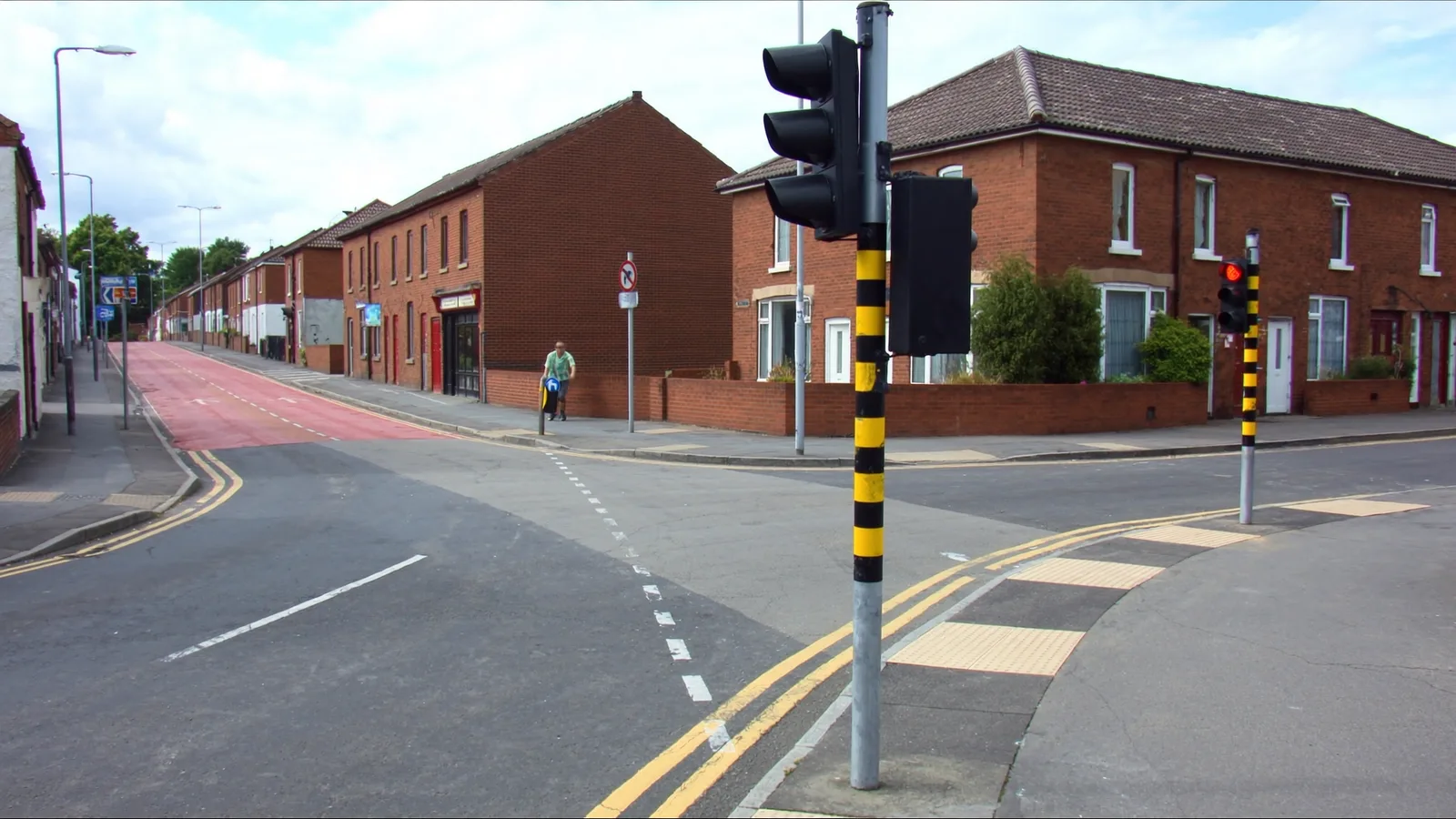
A traffic signal drawing shows poles, heads, detectors and a controller. What it does not show is that roughly three quarters of the work is underground, most of the risk is in the fortnight before commissioning, and the junction has to keep working throughout.
This is what a signal installation actually involves on a road that stays open.
The work is mostly civils
Before a single signal head goes up there is a ducting network to build. Ducts run between every pole position, every detector, the controller cabinet and the incoming power supply, with draw chambers at changes of direction and at spacing that lets cable be pulled without damage.
That network has to cross a live carriageway. Every crossing is a road space booking, a traffic management setup, a dig, a reinstatement to the highway authority’s specification, and an inspection. Directional drilling avoids some of it but not all, and it depends on what is already down there.
Which raises the point that decides the programme. Existing plant. Signal junctions sit at the busiest points on the network, which is exactly where gas, water, electricity, telecoms and street lighting all converge. Utility record drawings are indicative, not accurate. A junction with a full set of statutory undertakers under it is a hand dig job in the places that matter, and the pole positions on the drawing are a starting proposal rather than a fixed design.
Foundations are the other underground item. Signal pole and controller foundations are substantial, and they frequently conflict with the plant you have just spent a fortnight locating.
Power and connection
The controller needs a power supply. That is a new connection application to the distribution network operator, and it runs on their timescale. Applications made late are the single most common cause of an installation standing complete and unenergised.
There is a second connection to think about on many junctions. If the site is monitored or coordinated by the authority’s urban traffic control system, there is a communications link to arrange, and the authority’s signals team has to be booked to bring the site into their system.
Keeping the junction working
Almost no signal installation happens on a closed road. That means temporary signals, and temporary signals on a busy junction are a design task in their own right, not a hire item.
Portable signals need to be set to sensible timings for the actual flows, they need pedestrian provision where pedestrians are already crossing, and they need to be attended and adjusted. Queue lengths change through the day. A four way temporary setup that works at ten in the morning can gridlock at half four, and the calls the authority receives about it will land on your scheme.
Where staged working is possible it is usually better. Building one arm at a time, keeping the existing installation running, and switching over late is more expensive in preliminaries and cheaper in everything else.
Detection, and why it decides how the junction behaves
Modern installations are almost never fixed time. Vehicle detection determines how green time is allocated, and how the detection is installed determines whether the junction behaves as designed.
Inductive loops are cut into the carriageway surface and are sensitive to installation quality: slot depth, turns, sealant, feeder routing and splice quality all matter, and a loop cut into a surface that is due to be resurfaced next year is a loop that gets destroyed next year. Above ground detection avoids the cutting but needs clear sightlines and correct alignment, which means it needs to be commissioned in daylight and checked in the dark.
Pedestrian facilities carry their own requirements: push button units at the right height and orientation, tactile rotating cones on demand units, audible signals where appropriate, and tactile paving laid out correctly at the crossing point. This is regulated detail under the traffic signs regulations, not designer preference, and it is checked.
Commissioning is a formal event
Commissioning is not switching it on. It is a scheduled event with the authority’s signals engineer present, working through the controller configuration against the approved specification: stage sequence, intergreens, minimum greens, maximum greens, detector allocations, pedestrian timings, fault handling and the fallback mode.
Before that there is safety critical testing, and after it there is a period of monitoring where timings are adjusted against real behaviour on street. A junction that has just gone live is not a finished junction. It is a junction that needs watching for a fortnight.
Road markings and signing complete on the same programme. New markings need a dry surface at a workable temperature, which in Yorkshire in February is not a given, so the marking window is a real constraint on the switch on date rather than a detail.
What holds signal jobs up
In rough order of frequency:
- The power connection application, made too late
- Statutory undertaker plant found where the record drawings said it was not
- Road space refused, or granted with hours that halve the productive shift
- Design changes after approval, resetting the checking cycle
- Signals engineer availability for commissioning, because the authority has one team and a diary
- Weather closing the road marking window
Five of those six are booked, not built. They are all fixable at the front of a programme and expensive at the back of one.
Where we come in
Civcon delivers traffic signal schemes across West Yorkshire, including the civils, the ducting and chamber network, foundations, reinstatement and the traffic management around a live junction, working alongside signals specialists for the controller and commissioning end.
If you have a junction improvement, a new crossing or a signal upgrade to programme, talk to us early. The front of the programme is where signal schemes are won or lost.